Updates for July 2026
31 July 2026There are no updates to the Census for July 2026.
Two interesting matters were brought to the Project’s attention this past month. First, a hither-to unknown (to us) photograph of François Ravary SJ (mastermind of the bamboo organs of Shanghai, and the topic of Prof. Urrows’ book, François Ravary SJ, and a Sino-European Culture in Nineteenth-century Shanghai) was reported by one of our correspondents. This photo is not in the famous Album chinois of ca. 1860, but has appeared in a book published in 2013: Ludovic de Garnier des Garets: Lettres de Chine (Éditions de Poutan, 2013). The source cited in this book for the photo of Ravary, is the Archives Jésuites in Vanves, France. Prof. Urrows worked over a number of years with the Archives, and yet this photo was never brought to his attention. Inquiries are being made. We include a very poor photocopy image below. It seems this must have been taken around 1859 or a few years later.

Also this month a retrospective article was published in The Post Mag (the Sunday supplement to the (South China) Sunday Morning Post, 19 July 2026) about the famous Hong Kong photographer Liu Heung-shing. One of his photos shown in the article is a perfect example of EC, emulous culture, explained in the Acronyms tab of the FAQs, and one of the major critical tools advanced in Keys to the Kingdom. This shows one of the three (3!) replicas of the Parthenon in China, this one in the remote city of Lanzhou, capital of Gansu Province (1500 km from Beijing). A more telling example of the incongruity of EC is hard to imagine, with the high speed train below, and the soulless, uniform tower blocks above. At least Lanzhou — 1500 meters above sea level, on the Yellow River — has better and more authentic things to offer, such as its famous and delicious ‘hand-cut’ soup noodles with lamb (12% of the population of Lanzhou is Muslim.)
Coincidentally, CNN ran an article by journalist Sonia King, “China loves historic sites. Tourists don’t mind if they’re not the originals”, which touches on a major EC matter in China today. This involves fang gu (仿古, imitating antiquities). There is a long history in China of building fake antiquities, many of them originating in theme parks. This once included the ‘Sung Dynasty Village’ in Hong Kong, which was a part of the Lai Chi Kok Amusement Park (opened in 1951 and demolished in 1997.) King’s article details the more-recent ‘Gubei Water Town’, near Beijing (a fake Jiangnan Province riverine village), Datang Everbright City (“a frenetic revival of the golden age Tang dynasty”), and Kashgar Old City, a preposterous, sanitized fake built on the ruins of the actual old city, which was demolished in the 2010s. Not surprisingly, all these places allow you to rent period clothes, so that the cosplay fantasy can be complete in a dress sense. The article can be found at https://edition.cnn.com/travel/china-fanggu-faux-historical-towns-intl-hnk
Hits this Month: 1,837 (our record)
Organs in the Census: 223
Photo of the Month:
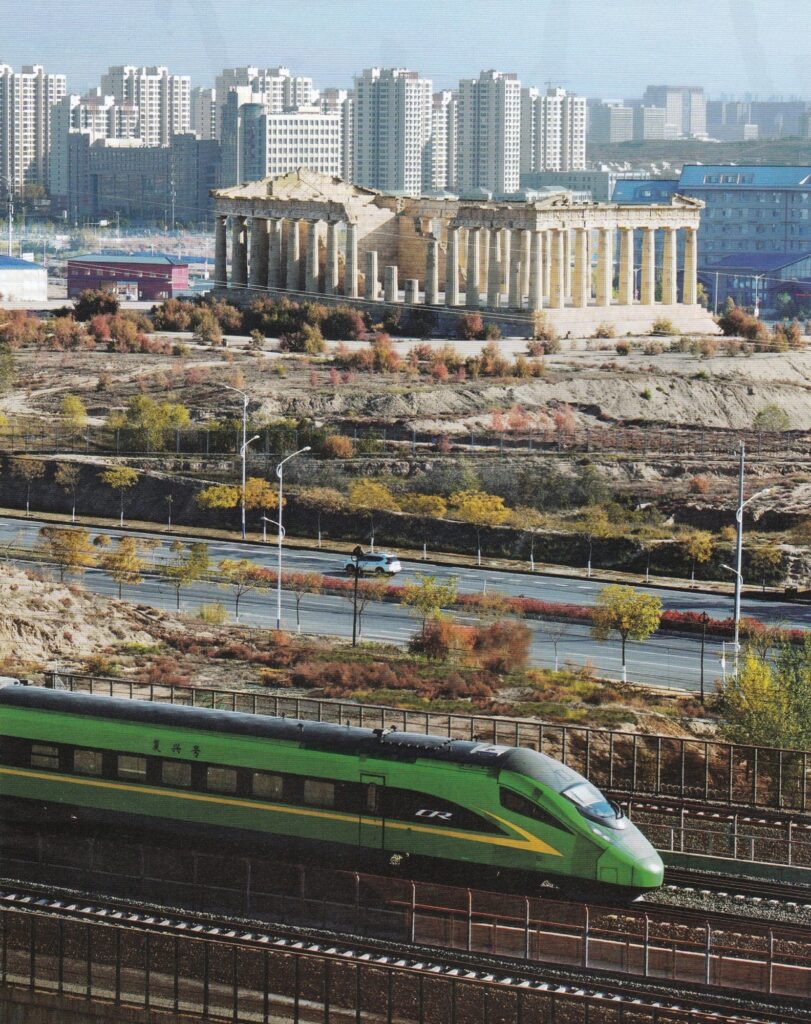
Lanzhou’s Parthenon replica, through the lens of Liu Heung-shing.